



Solar Battery vs Generator for Home Backup: Which Is Best?
When the power goes out, you want the lights to stay on. You have two main choices. Solar battery vs generator for home backup is the decision most homeowners face. One stores energy and releases it silently. The other burns fuel and runs for as long as you feed it. They solve the same problem in completely different ways. One is clean and quiet but limited. The other is loud and dirty but powerful.
This guide breaks down the pros and cons. It compares the costs. It explains which one fits which situation. No jargon Just clear answers. Read on and decide what works for your home.
Solar Battery vs Generator: The Core Difference
A solar battery is a large rechargeable battery. It stores electricity from your solar panels or the grid. When the power goes out, it releases that stored energy to your home. It is silent. It has no moving parts. It produces no fumes.
A backup generator is an engine. It burns natural gas, propane, or diesel to create electricity. It starts automatically when the grid fails. It can run for days or weeks as long as fuel is supplied. It is loud, It requires maintenance.
Read More: Battery Storage for Off-Grid Solar: Costs, Types, Sizing and Best Options
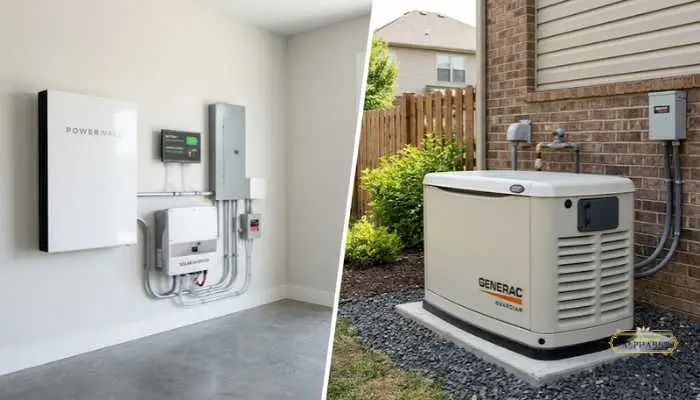
Solar Battery vs Generator for Home Backup Pros and Cons
Solar Battery Pros
- Silent operation. There is no engine noise. You can run it in a quiet neighborhood without complaints.
- No fuel. You do not need to store propane or diesel. You do not need to refill anything. The sun recharges it for free.
- Clean energy. No emissions. No carbon monoxide risk. It is safer indoors and outdoors.
- Bill savings. If you have time-of-use rates, the battery can store cheap grid power and use it during peak hours. It can lower your monthly bill, not just provide backup.
- Low maintenance. No oil changes. No filter replacements. No engine tune-ups. It just sits there and works .
Solar Battery Cons
- Limited runtime. A typical home battery lasts a few hours to a day, depending on your usage and battery size. It cannot power a whole home with central air conditioning for days. It is best for essential circuits like the fridge, lights, Wi-Fi, and medical devices .
- Recharge depends on the sun. If a storm knocks out the grid and the sky stays cloudy for days, your battery may not recharge fast enough. You could run out of power .
- High upfront cost. A solar battery system typically costs $10,000 to $20,000 installed, depending on size and electrical work .
Generator Pros
- Unlimited runtime. As long as you have fuel, it runs. It can power a whole home for days or weeks. It handles heavy loads like central air, well pumps, and electric ranges .
- Lower upfront cost. A standby generator typically costs $7,000 to $15,000 installed. That is less than a battery system .
- Automatic whole-home backup. It starts within seconds and can power everything. You do not have to choose which circuits to keep on .
Generator Cons
- Fuel dependency. You need a steady supply of natural gas or propane. If the fuel line is disrupted, it stops. Diesel requires manual refilling and storage.
- Noise and fumes. It is loud. It produces carbon monoxide. It cannot be installed indoors. It may annoy neighbors .
- Maintenance. Regular oil changes, filter replacements, and inspections are required. It needs exercise runs to stay reliable.
- No bill savings. It does nothing for your monthly electricity bill. It only runs during outages.
Solar Battery vs Generator for Home Backup Price
Here is how the costs compare for a typical home.
| System | Typical Installed Cost | Ongoing Costs |
|---|---|---|
| Solar Battery | $10,000 – $20,000 | Minimal |
| Standby Generator | $7,000 – $15,000 | Fuel + maintenance |
The battery costs more upfront. But it can pay you back through bill savings over time, especially if you have solar panels and time-of-use rates. The generator costs less upfront. But it costs more to run. Fuel and maintenance add up year after year .
For a 100 kWh backup need, a diesel generator can cost roughly $25 per kWh in fuel. A solar-charged battery can bring the effective cost down to $4 to $8 per kWh . The math favors the battery over a decade.
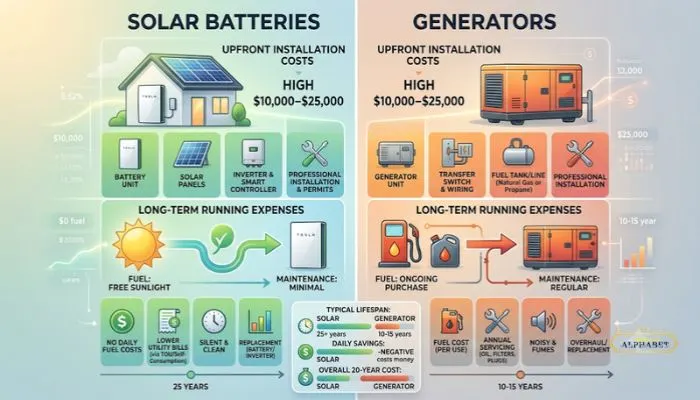
Solar Battery vs Generator for Home Backup Cost: What Drives the Price
Battery Costs
- The battery hardware is only part of the cost. Installation includes electrical work, a critical loads subpanel, permits, and inspections. If your home has an old electrical panel, it may need an upgrade. That can add thousands to the bill .
- The good news is battery prices are falling. Since 2010, residential battery system costs have dropped by 64% . The trend is in your favor.
Generator Costs
- The generator unit itself is $3,000 to $6,000 for a typical air-cooled model. The rest is installation: a concrete pad, a transfer switch, fuel line connection, electrical wiring, and permits. That adds $1,500 to $4,000 or more .
- Liquid-cooled units for large homes cost more. They can exceed $20,000 installed.
You May Also Read: AI Technology for Energy Access: Powering Remote Areas
Solar Panels vs Generator for Home
If you do not have solar panels yet, you might wonder if you should get them instead of a generator.
- Solar panels alone do not provide backup power during an outage. If you are connected to the grid, your panels shut off when the grid goes down. This is a safety feature to protect utility workers . You need a battery to keep the power on.
- So the real comparison is this: solar panels plus battery versus generator. Or generator alone.
If you want bill savings and backup, solar plus battery is the better long-term investment. If you only care about backup and want the lowest upfront cost, a generator is the simpler choice.
Which One Should You Choose?
Choose a solar battery if:
- Outages in your area are short (a few hours to a day)
- You want silent, clean backup
- You already have or plan to get solar panels
- You want to lower your electricity bill
- You are willing to pay more upfront for long-term savings
Choose a generator if:
- Outages in your area last for days
- You need to power your whole home, including AC and heavy appliances
- You want the lowest upfront cost
- You have a reliable fuel source (natural gas or a large propane tank)
- You do not mind noise and maintenance
Consider both if:
You want the best of both worlds. A battery handles short outages silently. A generator kicks in for extended events. This hybrid setup is becoming more common. The battery reduces generator runtime, saving fuel and reducing noise .
FAQs
1. Can a solar battery power my whole house during an outage?
It depends on the battery size and your usage. Most home batteries are designed to power essential circuits, not the whole house. Running central air conditioning for days would drain most batteries quickly. For whole-home backup, you need a very large battery system or a generator .
2. How long does a solar battery last during an outage?
A typical home battery lasts a few hours to a day. The exact time depends on the battery capacity and how much power you use. If you conserve energy and only run essentials, it can last longer .
3. How long can a generator run during an outage?
As long as you have fuel. A generator connected to a natural gas line can run indefinitely. A propane generator runs until the tank is empty. Diesel requires manual refilling. For multi-day outages, a generator is the more reliable option .
4. Is a generator cheaper than a solar battery?
Upfront, yes. A standby generator costs $7,000 to $15,000 installed. A solar battery costs $10,000 to $20,000. But the battery can save you money on your electricity bill. The generator only costs you money to run. Over 10 years, the battery can be the better financial choice .
5. Do I need solar panels to use a solar battery?
You can charge a battery from the grid, but the biggest benefit comes from pairing it with solar panels. Solar panels charge the battery for free. Without solar, the battery still provides backup and can help with time-of-use bill savings, but the payback is slower.
6. Can I use a generator and a solar battery together?
Yes. This is a growing trend. The battery handles short outages silently. The generator starts for extended outages. This reduces fuel consumption, noise, and wear on the generator. It gives you the best of both worlds .
7. How much maintenance does a generator need?
A generator needs regular oil changes, filter replacements, and inspections. It should be run periodically to stay reliable. Expect to spend $50 to $150 per year on maintenance kits. A solar battery has no moving parts and requires almost no maintenance .
8. Which is better for the environment?
The solar battery. It produces no emissions. It uses renewable energy if charged by solar. A generator burns fossil fuels and produces carbon monoxide and other pollutants. If environmental impact matters to you, the battery is the clear choice .