



Google Ventures AI Infrastructure Investments: Key Bets and Trends
Google Ventures is not sitting still while the AI boom unfolds. The firm, now known simply as GV, has been placing strategic bets on the companies building the backbone of artificial intelligence. These are not flashy consumer apps.
They are the chip designers, the software layers, and the infrastructure players that make AI work at scale. GV's approach is deliberate. It invests early, often leading the first round and it focuses on founders building technology that solves real problems. This guide covers Google Ventures AI infrastructure investments, its broader portfolio, its partners, and what it takes to build a career there.
What is Google Ventures AI Infrastructure Investments?
Google Ventures (GV) invests in the foundational technology that powers artificial intelligence, rather than the consumer-facing apps built on top. This includes companies working on data labeling, hardware-software integration, and inference optimization .
The firm was early to back this layer, with portfolio companies like Snorkel, SambaNova, Modular, and Lightmatter . A key example is Modular, a software platform for AI hardware, which was acquired by Qualcomm and delivered a significant return for GV . GV's managing partner has stated the firm was investing in infrastructure before the broader AI boom began .
Read More: What Is Google Ventures Investment Strategy? A Complete Guide

The AI Infrastructure Thesis
GV's interest in AI infrastructure is not new. The firm has backed chip startups like Groq and SambaNova for years . These companies design specialized hardware to make AI faster and cheaper. That focus continues.
In August 2026, GV Managing Partner Dave Munichiello explained the firm's thinking on Bloomberg. GV had already made strategic bets on AI infrastructure chip startups. Now it is looking further up the stack. The focus is shifting toward the application layer .
But infrastructure remains central. The firm's early bet on Modular is a clear example. Modular builds a software layer that sits on top of AI chips. It lets any model run on any chip. GV led the first round. Qualcomm later acquired Modular for $3.9 billion . That is the kind of outcome GV looks for.
Recent AI Infrastructure Investments
Flapping Airplanes
In October 2026, AI research lab Flapping Airplanes closed a $1 billion Series A round. GV participated alongside Index Ventures, Lux Capital, Sequoia, and Nvidia . The company is taking a "data-efficient" approach. It aims to train models with less data and compute. Its custom megakernel framework packs training and inference into a single GPU kernel to reduce idle time. The round valued the company at roughly $6 billion .
This investment shows GV's willingness to back unproven but ambitious infrastructure ideas. Flapping Airplanes has no commercial product yet. But its technical approach caught attention.
Guild.ai
GV led both the seed and Series A rounds for Guild.ai. The company raised $44 million at a $300 million valuation . Guild.ai helps businesses build, deploy, and monitor AI agents. It handles the full lifecycle from development to production.
One investor described it as "infrastructure, not another chatbot wrapper" . GV doubling down by leading both rounds signals conviction. The bet is on the picks and shovels of the AI agent economy.
Google Ventures Portfolio
GV's portfolio is broad. It spans enterprise software, life sciences, consumer, and frontier tech . The firm has 368 portfolio companies and 55 exits, including 49 acquisitions and 6 IPOs .
Notable AI and Tech Companies
Several GV portfolio companies appeared on Fast Company's Most Innovative Companies list for 2026. These include Altana AI, Harvey, Zipline, Plaid, Ramp, Snorkel AI, Warp, and Waymo .
The firm's AI infrastructure bets include chip makers like Groq and SambaNova. It has also backed application-layer companies like OpenEvidence and Harvey, which focus on healthcare and legal AI respectively .
Exit Track Record
GV has had notable exits. Modular was acquired by Qualcomm for $3.9 billion. Anysphere, maker of the Cursor coding tool, was acquired by SpaceX for $60 billion. Fin was acquired by Salesforce for $3.6 billion . These exits show GV's ability to pick winners.
Fund Size
GV has $13 billion under management. It operates offices in London, New York, Cambridge, and the Bay Area .
Google Investment Portfolio: How GV Fits In
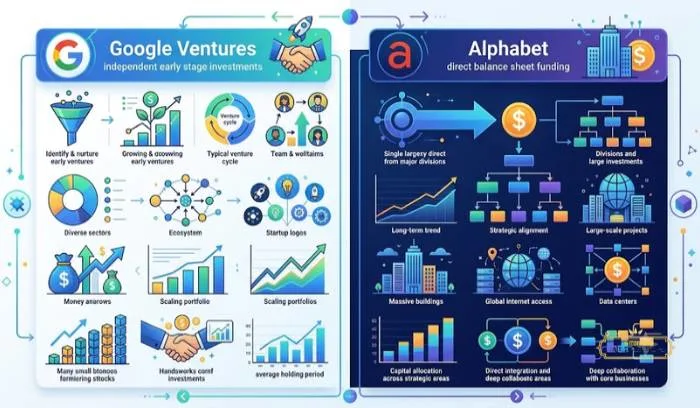
- GV is the venture capital arm of Alphabet. But it operates independently. It invests without regard for Alphabet's business strategy . Its sole limited partner is Alphabet.
- That independence matters. GV can back companies that might compete with Google products. It can invest in chip startups that challenge Nvidia, or AI labs that compete with Google's own models. The firm's job is to find the best founders, not to serve a corporate agenda.
- Alphabet also makes direct investments outside GV. Sundar Pichai has said Alphabet is increasingly deploying capital directly from its balance sheet, especially for large AI bets like Anthropic and Waymo . GV remains the early-stage vehicle. Direct investments handle the mega-rounds.
Google Ventures Partners
GV's partners are the people making the investment decisions. The firm's team spans offices in the US and Europe.
- Dave Munichiello is a Managing Partner. He has spoken publicly about GV's AI infrastructure strategy, including the Modular investment and the firm's focus on early-stage bets .
- Tom Hulme is a partner based in London. He has discussed GV's European investments, including Q.ai and Nothing. He focuses on voice interfaces, wearables, and AI applications .
- Kriztal Huang is a partner based in New York. She spends every other week in San Francisco due to the concentration of activity there .
Other partners listed in public records include David Reshef, Issi Rozen, David Schenkein, Luna Schmid, Vidu Shanmugarajah, and KJ Sidberry .
You May Also Read: How to Apply to Google Ventures for Funding Successfully
Google Ventures AI Infrastructure Investments Careers
Working at GV is not the same as working at Google. GV is a small, independent firm. Roles range from investment professionals to operational staff in marketing, design, and talent management .
What GV Looks For?
- The firm invests early. It often leads the first round. That means partners need sharp judgment about founders and technology. An interest in AI infrastructure is essential for roles focused on that sector.
- GV's job postings emphasize collaboration with founders, evaluating market opportunities, and providing strategic guidance. The work is hands-on. You are not just writing checks. You are helping companies grow .
How to Find Roles?
GV's careers page is the starting point. The firm also hires through its portfolio companies. Many GV-backed startups post jobs on platforms like ZipRecruiter and LinkedIn .
Salaries at Google (the parent company) are high. Software engineers report median total pay of over $300,000. Senior engineers report over $450,000 . GV's own compensation structure is not public. But venture capital roles typically combine salary with carry (a share of profits).
The Skills That Matter
For investment roles, GV looks for people who understand technology deeply. AI infrastructure is a technical field. You need to grasp how chips work, how models are trained, and where the bottlenecks are. Experience as a founder or operator helps. So does a track record of making good early-stage bets.
FAQs
1. What is Google Ventures' focus on AI infrastructure?
GV invests in the companies building the backbone of AI. This includes chip designers like Groq and SambaNova, software layers like Modular, and research labs like Flapping Airplanes. The firm looks for founders solving hard technical problems early .
2. What are some recent GV AI infrastructure investments?
GV participated in Flapping Airplanes' $1 billion Series A in October 2026. It also led both seed and Series A rounds for Guild.ai, an AI agent infrastructure company. Earlier bets include Modular, which Qualcomm acquired for $3.9 billion .
3. What does the Google Ventures portfolio include?
GV has 368 portfolio companies. Notable names include Waymo, Plaid, Ramp, Harvey, Zipline, and Snorkel AI. The portfolio spans AI, healthcare, fintech, and frontier tech .
4. Who are the Google Ventures partners?
Dave Munichiello is a Managing Partner. Tom Hulme is a London-based partner focused on European investments. Kriztal Huang is a New York-based partner. Other partners include David Reshef, Issi Rozen, and David Schenkein .
5. How does GV relate to Google's broader investment strategy?
GV is Alphabet's independent venture arm. It invests without regard for Google's business strategy. Alphabet also makes direct investments from its balance sheet for large AI bets. GV handles early-stage deals. Direct investments handle mega-rounds .
6. How can I get a job at Google Ventures?
Check GV's careers page and its portfolio companies' job boards. Roles range from investment professionals to operational staff. A deep understanding of technology, especially AI infrastructure, is essential for investment roles. Founder or operator experience helps .
7. What is GV's track record?
GV has had 55 exits, including 49 acquisitions and 6 IPOs. Notable exits include Modular (Qualcomm, $3.9B), Anysphere (SpaceX, $60B), and Fin (Salesforce, $3.6B) .
8. How much does GV have under management?
GV has $13 billion under management. It operates offices in London, New York, Cambridge, and the Bay Area .