


How Google DeepMind Develops AI Models: A Simple Guide
Google DeepMind does not build AI by accident. It starts with a hard problem. A game. A scientific puzzle. Then it builds systems that learn from experience. Not just from human data. The results are not just better scores. They become tools that solve real problems. Predicting protein structures. Proving mathematical theorems. Powering Gemini.
Learning how Google DeepMind develops AI models is learning how modern AI is built. Reinforcement learning. Self-play. Massive data generation. Integration with Gemini. This guide breaks down the process. It explains what the lab is working on now. And it shows you how to use some of its technology yourself. No jargon. Just the method behind the magic.
What Does Google DeepMind Do?
Google DeepMind is a research lab with one mission: build AI responsibly to benefit humanity . It was formed when Google Brain and DeepMind merged. The lab is led by CEO Demis Hassabis, who is also a Nobel Prize winner .
The lab's work spans several areas. It builds frontier models like Gemini, which powers many Google products. It develops AI for science, including AlphaFold for biology and AlphaProof for mathematics. It also works on robotics, world models, and responsible AI .
DeepMind does not just publish papers. It ships products. Its research underpins Google Search, Google Assistant, and the Gemini app. That combination of pure research and real-world deployment is what sets it apart.
Read More: DeepMind AI Projects List: From AlphaGo to AlphaGenome and Beyond
How Google DeepMind Develops AI Models?
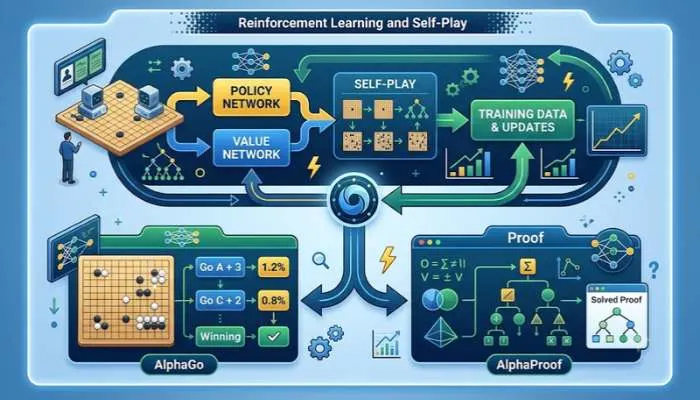
The lab's development process follows a pattern. It has worked for over a decade.
Start with a Hard Problem
DeepMind picks challenges that are difficult to solve with traditional programming. Games have been a proving ground. Go was a grand challenge for decades. AlphaGo solved it by combining deep neural networks with reinforcement learning and search .
The system learned from human games first. Then it played against itself hundreds of thousands of times. It discovered strategies humans had never seen. The famous "Move 37" in 2016 was so unconventional that commentators thought it was a mistake. It turned out to be decisive .
Use Reinforcement Learning and Self-Play
The core technique is reinforcement learning. The model learns by trying things, getting feedback, and adjusting. Self-play makes this powerful. AlphaGo Zero learned Go from random play, with no human data at all. AlphaZero generalized the approach to chess and shogi, mastering them in hours .
This method has been applied beyond games. AlphaProof turns mathematical proofs into a game. Each proposition is a level. The AI chooses tactics to advance the proof. It uses a 3-billion-parameter transformer model as its "brain" and a tree search inspired by AlphaZero .
Generate Data at Scale
For AlphaProof, the team needed millions of math problems. They built a translation system using Gemini 1.5 Pro. It converted about 1 million natural-language math problems into roughly 80 million formalized problems . This let the system train on a massive scale.
Combine with Gemini
Gemini is DeepMind's largest and most capable model family. It is a transformer-based mixture-of-experts architecture. It handles text, images, audio, and video natively . The newest models build on Gemini. AlphaProof's success laid groundwork for Gemini's Deep Think mode, which achieved gold-medal level at the 2025 International Mathematical Olympiad .
What Is Google DeepMind Working On?
The lab's current work spans several frontiers.
Gemini Models
Gemini is the core product. Recent releases include Gemini 3.8 Flash, a workhorse model for coding and agents, and Gemini Omni 1.1 Flash, which generates and edits video through conversation . These models power the Gemini app and API.
AI for Science
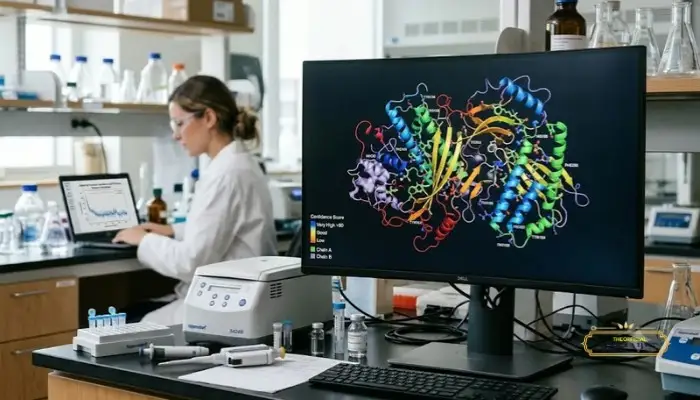
AlphaFold predicted the 3D structure of proteins, a 50-year grand challenge. The team folded structures for 200 million proteins and made them freely available. Over 3 million researchers use the database . The work won the 2024 Nobel Prize in Chemistry.
Other science tools include AlphaGenome for understanding DNA mutations and AlphaEvolve, a Gemini-powered coding agent that optimizes algorithms. AlphaEvolve has improved data center efficiency and chip design .
World Models and Robotics
Genie 4 is a world model that generates interactive environments. It can simulate physics, characters, and audio in real time. Users can change weather or camera angles mid-simulation . DeepMind is testing Genie 4 with Gemini to plan robot tasks. In one demo, Gemini broke a task into steps, and Genie simulated a humanoid robot playing checkers .
SIMA 2 is a generalist agent that plays games the way a human would. It sees the screen, understands natural language, and uses keyboard and mouse controls. It has played No Man's Sky, Valheim, and other complex 3D games .
Responsible AI
DeepMind partners with governments on AI safety. It works with Singapore and Korea on national AI strategies, including safety research and talent development . It also runs double-blind evaluations to test model safety .
Is Google DeepMind Generative AI?
Yes, partly. DeepMind builds generative models. Gemini generates text, code, images, and video. Genie generates interactive worlds. Lyria generates music. Veo generates video .
But DeepMind is broader than generative AI. Its reinforcement learning systems, like AlphaGo and AlphaProof, are not generative in the same way. They solve problems through search and planning. The lab's mission is AGI, not just content generation .
You May Also Read: DeepMind AI Software Features: A Complete Guide to Googles AI Models
How to Use DeepMind?

You cannot download DeepMind as a standalone product. Its technology reaches you through Google tools.
Gemini App and API
The Gemini app is the most direct way to use DeepMind models. It is free and available on web and mobile. You can also access Gemini through Google AI Studio. The API lets developers build with the models .
Google Products
DeepMind research powers Google Search, Google Assistant, and Google Photos. AlphaFold's database is free for researchers.
Open Models
Gemma is DeepMind's family of open models. You can download and run them on your own hardware. They are designed for developers who want more control .
Research Access
Some tools are available to researchers through partnerships. Genie 4 is rolling out to Google AI Ultra subscribers and early-access partners . Scientific tools like AlphaEvolve are used in collaboration with research institutions .
FAQs
1. How does Google DeepMind develop AI models?
It starts with a hard problem, often a game or scientific challenge. It uses reinforcement learning and self-play to let models learn from experience. It generates training data at scale. Then it integrates the results into larger models like Gemini .
2. Is Google DeepMind generative AI?
Partly. Gemini, Genie, and Veo are generative models. But DeepMind also builds reinforcement learning systems like AlphaGo and AlphaProof, which are not primarily generative. The lab's mission is broader: build AI to benefit humanity, with AGI as the long-term goal .
3. What does Google DeepMind do?
It builds frontier AI models (Gemini), AI for science (AlphaFold, AlphaProof), world models (Genie), robotics agents (SIMA), and responsible AI research. Its work powers Google products and is published openly .
4. What is Google DeepMind working on now?
Gemini 3.8 and Omni models. Genie 4 world models. SIMA 2 gaming agents. AlphaEvolve for algorithm discovery. National AI partnerships with Singapore and Korea. And safety evaluations for frontier models .
5. How can I use DeepMind?
Use the Gemini app or API. Use Google products that incorporate DeepMind research. Download open Gemma models. Researchers can access some tools through partnerships .
6. What is the difference between DeepMind and Google Brain?
They merged in 2023 to form Google DeepMind. Brain focused on Google products and infrastructure. DeepMind focused on AGI research and science. The combined lab does both .
7. Did DeepMind win a Nobel Prize?
Yes. Demis Hassabis and John Jumper won the 2024 Nobel Prize in Chemistry for AlphaFold, alongside David Baker .
8. What is AlphaGo?
An AI system that defeated a world champion Go player in 2016. It used deep neural networks, reinforcement learning, and search. Its methods influenced later systems like AlphaZero, AlphaFold, and AlphaProof .