


Artificial Intelligence (AI) and Web3: How They Connect
Two cutting-edge technologies that are reshaping the digital landscape and data management are Artificial Intelligence (AI) and Web3.Artificial Intelligence (AI) and Web3 are two transformative technologies that are revolutionizing digital usage and data handling. AI enhances data analysis, decision making, task automation, and customization, while Web3 emphasizes decentralization, blockchain technology, transparency, and user ownership.
These technologies combined can develop smarter and secure digital ecosystems. AI has the potential to unlock the full potential of Web3 with the help of autonomous agents, decentralized data marketplaces, predictive analytics, cybersecurity, personalization, and decentralized autonomous organizations (DAOs). This relationship can bring the Web3 applications more efficiency and empower the users to control their data and digital activities.
What is AI?
Simply put, Strained Intelligence (AI) is the worthiness of machines to do functions that we usually socialize with a human mind – for example, doing a reasoning task, solving a mathematics problem, stock market trading, and much more. At its core, AI combines computer science with robust datasets to enable problem-solving.
Since its inception, AI has had many cycles of hype, but the release of OpenAI’s ChatGPT last year has taken the excitement and vaticination of AI to new heights, marking a significant milestone, particularly in the field of Natural Language Processing. Furthermore, generative models have proven their tensility vastitude language, showcasing the topics to learn the grammar of diverse data types such as software code, molecules, natural images, and more.
The applications of AI are evolving day by day, and in this article, we will discuss its role and use cases in Web3.
What is Web3?
Web3 is specified as a series of inter-connected and open-source applications. Powered by the blockchain computing architecture, these applications are decentralized, enabling trust and transparency where data and transactions are secured and distributed wideness a network of nodes, eliminating the need for inside authorities or intermediaries.
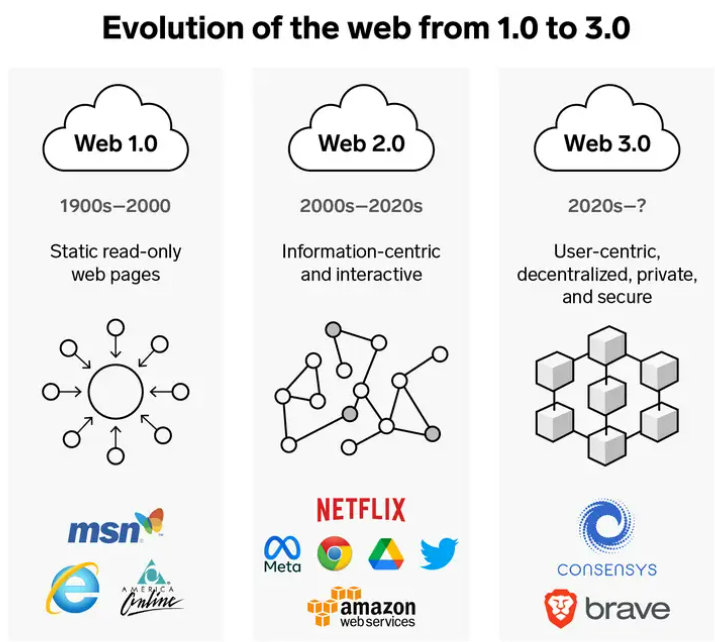
Web1 (1990-2004) was static and read-only (e.g. Yahoo News), with users consuming information. Web2 introduced interactivity (e.g., Facebook, YouTube) but led to privacy concerns (exploiting user data for targeted advertising) and internal tenancy (making decisions unilaterally, like blocking any particular account). Web3 aims to be decentralized, giving users ownership and governance through blockchain, addressing Web2’s limitations, and fostering a increasingly user-controlled internet.
An example of a Web3 using is the Brave Browser, a Chromium-based browser renowned for its Web3 integration and cryptocurrency integration. Operating on public blockchains and leveraging IPFS (a transfer protocol that sends and delivers data faster than HTTPS), Brave enables users to earn crypto, link wallets, explore NFTs, and wangle DApps seamlessly. With robust security features and a focus on online safety, Brave offers an platonic browsing wits for Web3 enthusiasts.
Role of AI in Web3
Autonomous Agents
Autonomous Teachers could be provided with real-time data and a set of predefined rules to enhance the capabilities of smart contracts in Web3 platforms. Additionally, these teachers can negotiate, execute transactions, and provide personalized services. The use of such teachers automates ramified processes, minimizes intermediaries, and enhances the overall Web3 ecosystem.
Personalization
In the Web3 context, strained intelligence (AI) is pivotal in crafting tailored user experiences through data analysis, interaction patterns, and preferences. AI employs collaborative and content-based filtering techniques, generating personalized recommendations and enhancing various facets of Web3 platforms.
Such personalization fosters deeper user engagement by aligning content and interactions with individual needs and preferences, ultimately enriching the decentralized Web3 wits and facilitating efficient content discovery and curation.
Decentralized Data Marketplaces
By harnessing AI, decentralized data marketplaces can be created that empower individuals with enhanced data control. AI algorithms enable selective data sharing and monetization while upholding privacy. They facilitate data analysis, categorization, and efficient, secure transactions, optimizing matching between data buyers and sellers in these decentralized markets.
Analytics & Insights
By leveraging AI methods like machine learning and natural language processing, Web3 networks can efficiently process and unriddle wide-stretching data. This empowers users with predictive analytics, sentiment analysis, and personalized recommendations, enhancing their understanding of decentralized dynamics and improving navigation within the landscape.
Security & Privacy
Web3 ecosystems can modernize cybersecurity and safeguard user data privacy by utilizing wide AI techniques. AI models can unriddle wide-stretching data to identify vulnerabilities, malicious behavior, and anomalies. Machine learning algorithms can prevent cyber threats like phishing and DDoS attacks. By proactively ensuring security, AI enhances user trust and conviction in Web3 platforms and applications.
Decentralized Voluntary Organizations (DAOs)
AI is pivotal in the minutiae of Decentralized Voluntary Organizations (DAOs). These blockchain-based organizations automate voting, fund management, and operations and unzip greater transparency and tensility by integrating AI and optimizing Web3 governance models.
Real-World Examples of Use of AI in Web3
Medibloc

Medibloc, a decentralized healthcare platform, utilizes the Ethereum blockchain and smart contracts to facilitate secure data sharing and healthcare access. Its native cryptocurrency, MED, supports transactions and rewards for data contributions.
AI is harnessed for personalized treatment advice, data analysis, and automation. The platform fosters patient connections and wits sharing while AI processes medical data, spotting trends, generating tailored recommendations, and automating tasks like medication reminders.
Chainalysis
Chainalysis, established in 2014, is a blockchain analytics platform utilized by various entities, including cryptocurrency exchanges, law enforcement, and financial institutions, to uncover and prevent unlawful activities within the blockchain.
The platform employs a proprietary database of known illicit addresses and transactions to centrally store the data from diverse blockchain networks like Bitcoin and Ethereum. The system detects irregularities like unusually large transactions or links to fraudulent addresses through AI-driven processing, subsequently issuing alerts for potentially suspicious transactions.
Augur
Augur is a decentralized prediction market on the Ethereum blockchain. Users create and trade event outcome predictions, aided by AI that analyzes diverse data sources like news, social media, and historical data to enhance accuracy. This wringer guides users in making increasingly informed predictions and trades, with well-judged predictions earning rewards fostering AI-driven prediction improvement.
Ocean Protocol
Ocean Protocol focuses on constructing a decentralized data mart for secure data sharing and monetization, safeguarding privacy. The company’s telescopic extends to developing decentralized voluntary organizations (DAOs) and other Web 3.0 innovations.
Enterprises contribute supply uniting data to the platform, with Ocean Protocol’s AI processing it to pericope valuable insights, aiding in supply uniting enhancement such as identifying bottlenecks and predicting demand. The system automates tasks like issue resolution and logistics optimization. Data services are facilitated by the native cryptocurrency, Ocean Token (OCEAN).
MyCryptoHeroes
MyCryptoHeroes is a blockchain-based gaming platform where players collect, train, and wrestle with distinctive digital heroes using non-fungible tokens (NFTs) on the Ethereum blockchain. The platform’s native cryptocurrency, GUM, acquires in-game resources and facilitates trades, while AI offers personalized suggestions and automates tasks. Alongside this, a social dimension enables hero trading and player interaction within the game.
Conclusion
The connection between Artificial Intelligence (AI) and Web3 is creating new opportunities for smarter, more secure, and decentralized digital experiences. Web3 platforms can leverage AI to handle data analysis, automate certain tasks, enhance security measures, and provide personalized services. Meanwhile, Web3 can offer AI systems decentralized data, transparency, and enhanced user control.
The convergence of both technologies might have significant implications in sectors like the decentralized finance sector, the gaming industry, digital identity, data ownership, and DAOs.
FAQs
1. What is the connection between Artificial Intelligence and Web3?
Artificial Intelligence (AI) and Web3 can work together to create smarter decentralized applications. AI can analyze data, automate processes, improve security, and personalize Web3 experiences.
2. How does AI help Web3?
AI helps Web3 with autonomous agents, data analysis, personalized recommendations, threat detection, smart contract automation, and decentralized data management.
3. Can AI improve Web3 security?
Yes. AI can identify unusual activity, potential vulnerabilities, malicious behavior, phishing attempts, and other security threats across Web3 networks.
4. How are AI and blockchain connected?
Blockchain provides decentralized and transparent data infrastructure, while AI can analyze that data and automate decisions. Together, they can support smarter digital applications.
5. What are examples of AI in Web3?
Examples include blockchain analytics, decentralized data marketplaces, AI-powered prediction platforms, personalized blockchain gaming, automated smart contracts, and DAO management.